
Rule-based Verification#
Concept#
Rule-based Verification is the native Bacularis verification method. It uses extensible checker plugins and Verification Rules to validate restored data against configured conditions.
Its goal is to answer a practical recovery question: “Can I actually restore and use the data I need from this backup?”
How it works#
Rule-based Verification is configured as part of a Restore Test.
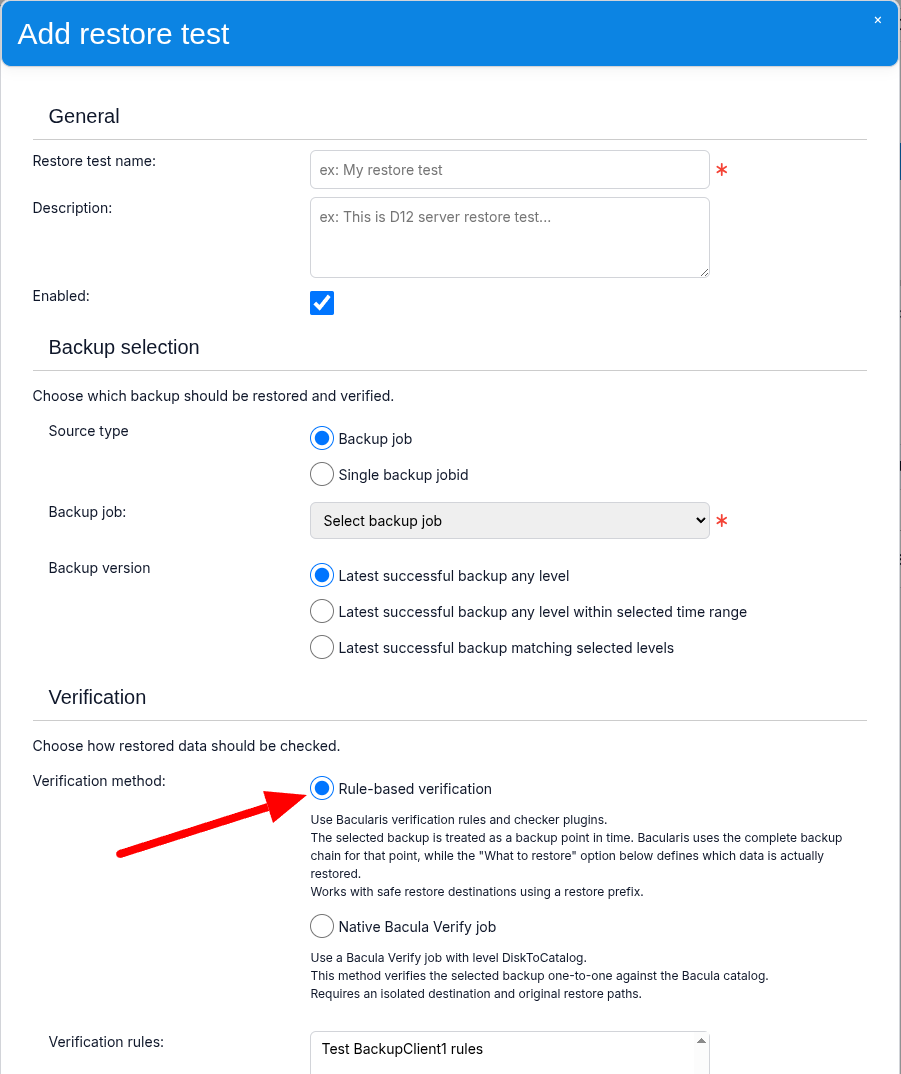
Verification is started by the Restore Job immediately after the selected data has been successfully restored to the configured Restore Destination.
Checker plugins are used to evaluate the configured conditions against the restored data. The checker plugins run directly on the Restore Destination after the restore has completed successfully.
At the end of the test, a report is written to the Restore Job log. The report contains detailed results for the individual verification checks.
If any verification check fails, the Restore Job finishes with an error status.

Restore point and backup chain#
Rule-based Verification does not treat the selected JobId as an isolated backup.
Instead, it treats it as a restore point representing the state of the protected
data at that moment.
This means that the method focuses on whether the protected data can be reconstructed and used, rather than treating the selected backup Job as an isolated unit.
If the selected JobId is Differential or Incremental, Bacularis includes
the required preceding backups from the same backup chain so that the restore
point can be reconstructed consistently.
The selected JobId therefore defines the endpoint of the restore point, not
necessarily the complete set of Jobs used during the restore.
Restore scope#
The restore scope defines which data from the selected restore point should be restored to the Restore Destination.
The restore scope is applied only after Bacularis has determined the complete backup chain required for the restore point. The data selection therefore operates on a consistent reconstructed backup state rather than on an individual JobId.
Three restore scope options are available:
Entire backup restore point – restores all data belonging to the selected restore point. Verification checks are then performed for the paths defined in the selected Verification Rules.
All paths from Verification Rules – restores only the paths defined in the selected Verification Rules.
Random paths from Verification Rules – restores a random subset of paths defined in the selected Verification Rules. Only verification conditions assigned to the selected paths are executed.
Verification Rules#
Verification Rules define the criteria used by Rule-based Verification.
They can be configured on the following page:
[Main menu] => [Page: Jobs] => [Tab: Restore Verification] => [SubTab: Verification rules]
Verification Rules define both what should be checked and how it should be checked. This is where conditions used by checker plugins are configured.
Configured Verification Rules are assigned to Restore Tests and used during verification.
Verification Rules are available only with the Rule-based Verification method.
Checker execution#
During verification, checker plugins receive the data required for a check, read the actual value from the restored data, and compare it with the configured expected value using the selected operator.
The comparison can be represented as:
ACTUAL VALUE <OPERATOR> EXPECTED VALUE → PASSED / FAILED
Example:
537248 > 0 → PASSED
Configuration#
Configuring Rule-based Verification consists of several steps:
Create Verification Rules.
Configure a compatible Restore Destination, usually using Safe prefixed restore.
Select Rule-based Verification in the Restore Test.
Assign one or more Verification Rules.
Select the restore scope.
When to use Rule-based Verification#
Rule-based Verification is a good choice when you need:
flexible restore scopes,
verification of selected files or paths,
safe prefixed restore destinations,
custom checker logic,
application-level or data-level recovery tests.
Advantages#
Rule-based Verification provides the following advantages:
restore-point-based verification using the required backup chain,
support for Full, Differential, and Incremental backups,
flexible restore scope,
support for safe prefixed restore paths,
reusable Verification Rules,
extensible checker plugin architecture,
ability to verify simple and complex recovery targets such as files, directories, database dumps, virtual machines, and application data.
Limitations#
Rule-based Verification has the following limitations:
it requires a compatible Restore Destination,
checker coverage depends on the available checker plugins,
custom application-level checks may require development of custom checker plugins,
verification results are based on configured rules, so data not covered by those rules is not automatically validated.